Let’s see what we are covering in this guide:
- All you need to know about the Certifications
- Requirements for each certification
- Comparison between RBT, BCaBA, and BCBA
- How to apply: Step by step
- Questions you might have about the certifications.
- Final thoughts
What certification do you go for when you are into Applied Behavior Analysis? This article has the answer!
Suppose you are deep into the world of Applied Behavior Analysis (ABA), which is the science behind understanding and improving human behavior. In that case, you have probably come across a few scientific words that may sound alien at first glance.
Yes, we are talking about RBT, BCaBA, and BCBA.
Imagine each of them as game levels – the more certifications you have, the more eligible you become, the higher game level you play. But here’s the twist – each requires different academic qualifications, patience, and comes with different salary benefits.
In this guide, we will walk you through precisely what each certification indicates, the kind of work you’ll be accomplishing, and the level of education and training you will need.
In short, a guideline for you to decide what you are going to do next.
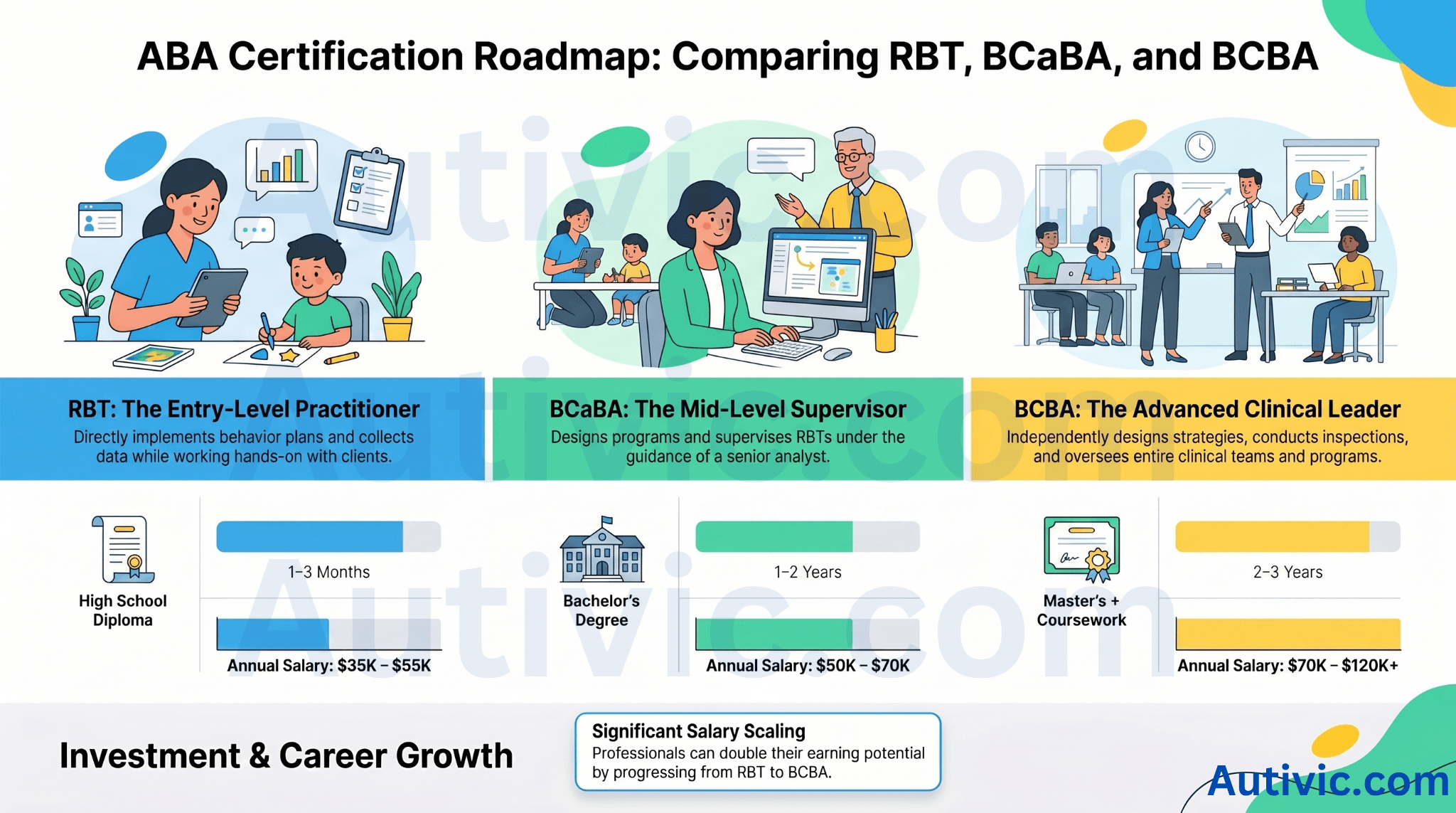
All about Certifications: RBT, BCaBA, and BCBA Explained!
When thinking about ABA certifications, think of it like a success ladder. The more you climb, the more wisdom you achieve and the more important you become. More importantly, each step changes what you will be doing every day.
What is RBT (Registered Behavior Technicians)?
This one is the most basic training you should go for. It gets to work with the client directly. They primarily engage with one-on-one sessions with their clients, who are often children, often dealing with autism or other developmental needs, to apply ABA principles.
What are the responsibilities of an RBT?
You have already guessed it. It is the treatment plan implementation by the RBT, which is being supervised by Board Certified Assistant Behavior Analysts (BCaBAs) or Board-Certified Behavior Analysts (BCBAs).
Their duties also involve maintaining sessions to help the clients gain adaptive skills, functional communication, successful social communications, interactions, and activities of our daily life, including personal hygiene.
They also collect, record, and observe the data of their clients to provide real-time advice and observations to the supervisory clinical team. They act as the primary focus of instant information regarding client performance.
What are the requirements for RBT Certification?
Since it requires one-on-one interaction and ground-level work, it is an entry-level career. They are not independent and are supervised by a certified behavioral professional.
But the role requires immense patience, intelligence, and emotional support, and is considered the most effective pathway for accumulating the required practical ABA experience.
You will only need a high school diploma (minimum age 18) to apply to become an RBT.
This is a short online course of 40 hours (training of 1-3 months), and there will be assessments marking your journey. That is, you can get trained at home and apply for the examination.
It costs approximately $100-$300 without the exam fees. If you pass it, welcome to the family!
Explore our complete RBT study guide for free!
What is BCaBA?
Now that you are done with RBT, the base level, it’s time to see if you have got that bachelor’s degree or not. If yes, this is your time to level up your game in the world of ABA. That is, to become the Board-Certified Assistant Behavior Analyst (BCaBA).
If you’re thinking this is just a small step or a slight upgrade only, this is where you are wrong. This is your entry towards a crucial mid-level position that deals with leadership. Here, you are not helping to execute the plans anymore; you are an assistant to the ones designing them!
What are the responsibilities of a BCaBA?
BCaBA is one step ahead of the RBT as they can design and tweak plans from just implementing behaviour plans. Basically, you now have the power to adjust and modify the strategies based on what you think is needed for the clients.
You’ll know the needs by collecting and analyzing data of the clients and tracking the progress to make data-driven decisions. So, you were complaining about only following orders; this is your call.
That does not end there; you will also have to train and supervise the RBTs (Registered Behavior Technicians) as you become the immediate supervisor of everything.
But you are not completely independent here; you will still need professional oversight from a BCBA (Board Certified Behavior Analyst). So if you are someone with an analytical mind and love numbers to make new decisions, you are going to love this position.
Before you take the final decision, see if the application requirements fit your criteria. Other than having the above-mentioned qualities, if you are not ready to commit to grad school yet, you can give this one a go.
What are the requirements for BCaBA Certification?
This is a mid-level profession, and you must have a bachelor’s degree in psychology, medicine, or a similar field. Keep in mind that you will be supervised by a BCBA when required.
What is BCBA?
BCBA people are known as the leaders in the clinical world. They are responsible for conducting behavioral assessments, taking data from that, forming data-driven decisions, and providing advice to families, institutions, and organizations.
What are the responsibilities of a BCBA?
They have to make sure that all the methods are effective and have a positive impact on their clients. Basically, they are the ones behind the planning and supervising, guiding under scientifically grounded, ethical, and persuasive methods.
What they really do is – They supervise and manage all the teams of BCaBAs and RBTs to cooperate with other professionals to make a contribution in policy, and other clinical supervisions.
What are the requirements for RBT Certification?
If you are someone who is planning to finish grad school and aiming for higher studies or learning in general, you need to give this one a go.
A BCBA requires a higher degree to apply and a strong determination to research and leadership.
The differences do not end here; we’ll elaborate more in our next section.
The Core differences: At a glance
It can be hard to read through all these and still get confused. This is why we have come up with a comparison table for you to see all the differences and requirements for a quick decision. The table shows the core points that makes the three certifications differ from each other.
This will help you to choose the best one for you.
|
RBT |
BCaBA |
BCBA |
| The full form is Registered Behavior Technician | The full form is Board Certified Assistant Behavior Analyst | The full form is Board Certified Behavior Analyst |
| This is an entry-level position and you have been directly involved with the clients. | This is a mid-level position and while you do not have to directly associate with the clients, you will have to supervise RBTs into assisting them. | This is an advanced-level position where you will plan and design strategies and take data-driven decisions. |
| Assists the clients directly and collects data related to behaviour. | They help to design, take notes and modify programs accordingly. They supervise RBTs when necessary. | Develops treatment plans, guides teams, supervises BCaBAs & RBTs |
| You will need a high school diploma and a 40-hour training for tbe qualified for this role. | You will need a bachelor’s degree. Rather than ABA coursework. | As this one is advance, you will need a master’s degree + ABA coursework |
| You will be supervised under a BCaBA or BCBA. | They supervise RBTs and work under a BCBA. | They work independently and supervises others |
| Needs hands-on teaching with clients. | Have to do data analysis, apprenticeship and program management | Conduct inspections, design interventions, oversee staff |
| Duration is of 1–3 months | Roughly around 1–2 years | Requires at least 2–3 years |
| Annual salary is $35K–$55K | Annual salary is $50K–$70K | Annual salary is $70K–$120K+ and it could be more depending on expertise and certifications |
| Best for beginners who want to join the ABA field quickly | Need a Bachelor’s degree students who enjoy more responsibility | Those aiming to guide programs, examination or start their own practice |
Which one should you choose?
Now that the dissimilarities between RBT, BCaBA, and BCBA are apparent, here comes the big question: Which certification is the right fit for you?
Whatever you choose will solely depend on where you’re at this moment—your recent qualifications, your education, and work experience—including what you want to accomplish in the next few years.
Go for RBT (Registered Behavior Technician) if you are just starting:
If you are someone who wants to enter the field right NOW, it is the fastest way to enter the ABA field. All you need to do is complete your 40-hour training. Once you pass the exam and start working within months, you will gain hands-on experience and grasp the core principles of behavior analysis. Only then will you see real progress with clients every day.
It also serves as a great ‘test drive’ to test if you are fit for future roles in this field. If you happen to fall in love with the work in the process, it’s a sign that you should keep pursuing it. You will need to level up to BCaBA or BCBA for the next time.
It’s also a great “test drive.” If you fall in love with the work (and many people do!), you’ll have a strong foundation to move up later to BCaBA or BCBA. In a nutshell, it is beginner-friendly, perfect for those who are looking to explore this field and for good bucks!
Start your preparation with our free RBT practice exam online.
Go for BCaBA (Board Certified Assistant Behavior Analyst) if you already have a Bachelor’s Degree.
You will only be eligible if you have a bachelor’s degree in a relevant field – that is, in psychology and related fields. That is, you are ready for more responsibilities now.
The responsibilities are already explained above, and you will do extensive work with that. The perks are no less if compared with those with the annual salaries of RBTs: it’s almost twice if you think about it!
You will need to know and have problem-solving abilities, and if you love to design, supervise, and sometimes work in the field, this is your call!
But remember, if you are going for a master’s, this might not be the one for you.
Go for BCBA (Board Certified Behavior Analyst) if you love leadership and authority
This is the highest you can go in the field of ABA certification. BCBAs are the people who form the strategies, work independently, conduct assessments, etc. If these sound interesting to you, you might move forward with this one.
Keep in mind that, as this is the highest and an important position, you will need higher degrees for this role. Your job would be making important decisions, so you should have the ability to conduct those too.
Although it is a long journey, it opens doors for future opportunities and meaningful career growth.
How to apply for RBT, BCaBA, and BCBA
Let’s assume you are a beginner, only here to explore the world of ABA. Here’s how you will apply to an entry level position, that is, for the position of RBT (Registered Behaviour Technicians):
How to apply for an RBT:
- First things first, you need to see if you are eligible to meet the basics. You need to meet the basics: to be an adult (18+ years old), you need to have a high school diploma. Other than that, your background will be checked.
- You need to complete the 40-Hour RBT Training through online, or universities. The training will cover ethics, behaviour analysis, data collection, and many more.
- You will need to pass the competency assessment. This will be conducted by a certified BCaBA or BCBA.
- After you have assured the previous steps, you can apply on the BACB website.
Once you are done, your application is approved. Pass the evaluation exam with Pearson VUE and you’re now officially an RBT!
How to apply for a BCaBA:
- Check the eligibility! You need to have a Bachelor’s Degree in psychology, education, behaviour analysis, or any relevant field.
- You need to complete the approved ABA coursework through university programs, online, or verified course sequences.
- You need to have hands-on training under a BCBA with approved working hours.
- You’ll now apply using BACB Portal.
- Pass it and you’re onboard!
How to apply for a BCBA:
- You will need a Master’s Degree here in psychology, education, or any related field.
- You will then complete assessments, plans, supervision by using ABA principles under a Verified Course Sequence.
- You will need to complete supervised fieldwork after that, which is 1500-2000 hours.
- After you’ve applied through the BACB Portal, you need to get it approved.
- Take the test through Pearson VUE and you’re officially a BCBA with independent practice privileges!
FAQs (Frequently Asked Questions):
Here are some frequently asked questions on the internet:
1. What’s the main difference between RBT, BCaBA, and BCBA?
RBTs focus on implementing plans, BCaBA assists in implementing, designing and supervising, and BCBAs creates and leads the entire process.
2. Which certification is best for beginners?
RBT, without any question! It only needs a high school diploma and a 40-hour training course, and you are done!
3. Can I become a BCaBA without being an RBT first?
Of course, there are no numericals that you need to follow!
4. How long does it take to get each certification?
- For RBT: You need to wait 1–3 months
- For BCaBA: 1–2 years will be enough
- For BCBA: 2–3 years ideally, but it can extend according to Master’s time duration and fieldwork
5. Which certification has the highest salary?
Considering all the experience, educational qualifications, and certificates that you need to become a BCBA, it is undoubtedly the position that pays the best. It pays around 70K to 120K dollars depending on degrees and fieldwork.
Final Thoughts
It doesn’t matter where you start, but you are entering the exact same field and will be dealing with the same kind of clients every single day. Our final suggestion would be to sit with yourself for a while and ask yourself questions: What do you want?
Ask yourself about the above factors. If you can afford to study a little longer, the best suggestion would be to apply for BCBA directly and have the highest position to later develop skills.
If you want a shorter training course and less hassle, and just want to get introduced to the world of ABA (Applied Behavior Analysis), there is no better option than to apply for the entry position called the RBTs (Registered Behavior Technicians).
Since you will be working directly with the clients, this will help you to get a deeper understanding of the data-driven decisions (which will help you later if you want to stay in this field in a higher position).
If neither of them is making sense to you, we have a BCaBA (Board Certified Behavior Analyst) welcoming you with open arms!

Ohita Salam
Ohita Salam is a lead content author at Autivic, where she specializes in curating research-driven, clear, and pragmatic educational resources and blogs to assist aspiring RBTs i.e. Registered Behavior Technicians in learning ABA principles, key RBT concepts, and their practical applications efficiently.
- Ohita Salam

- Ohita Salam
- Ohita Salam
- Ohita Salam