
RBTs (Registered Behavior Technicians) might seem like a hard job. If you ask us our opinion on it, we won’t deny the allegations. Instead, we would like to add that this hard work is generously appreciated.
If you already know about the deets on what an RBT has to go through throughout the day, you know the hard work. What RBTs actually do is directly related to clients, observing the clients and planning according to that under a supervisor.
If this is something that intrigues you, you are at the right place!
Now that you’re thinking of becoming a Registered Behavior Technician (RBT), you must learn about how much RBTs get paid. To get a deeper understanding of it, you must know what they do every day to be able to get that much.
In this guide, we will go through the everyday life of an RBT – teaching you what to expect if you become one. We will also elaborate on the kind of situations that an RBT faces every day.
Good news for you – we have also updated the salary expectations of an RBT as of 2026, the increment expectations, and the future prospects of the career.
Let’s get you started!
A Day in Life with an RBT: What do they actually do?
RBTs are the ready-to-go team members who are always ready to assist the supervisors and the clients. Most of their work time is occupied by clients of different ages. RBTs help to build skills and practice to reduce condemnable behavior through approved principles by the board.
A client’s best friend
An RBT helps the client in one-on-one sessions. That is, they help one client at a time. While responsibilities may vary from person to person, this may narrow down to –
- RBTs help in the daily lives of the clients. For example, getting them dressed, brushed, etc., in their home.
- They apply approved behavioral principles in therapy or teaching programs.
- Acts as an assistant to support the client during sessions, classrooms, etc.
- They help build real-world skills, such as at the park and grocery stores.
Session by session, the RBT becomes aware and takes lessons from the client’s preferences, triggers, and learning style. They use that information to apply and follow the BCBA’s plan.
Assists in teaching daily living skills
RBTs help in teaching day-to-day life skills through techniques that are approved by the board. Their work may include, but is not limited to:
- RBTs help clients use signs, pictures, words, or gestures to express their basic needs, wants, or to express emotions.
- They help to build social skills by practicing taking turns, sharing conversations, communicating with peers, and expressing their needs etc.
- The most important skill is daily living skills, and RBTs do a great job teaching them. This may include teaching them simple household chores, hygiene, dressing, etc.
So, RBT uses methods from Applied Behavior Analysis (ABA) to break complex tasks into small tasks through approved techniques so that the client can use them correctly.
Follows the behavioral plans
RBTs are not responsible for creating new plans; rather, they are the ones following orders and plans written by BCBAs. These plans are mainly wrapped with the kind of skills to teach the clients and in what order.
BCBAs also decide the kind of reinforcement they have to use and the strategies to prevent challenging behaviors.
They apply all these and examine if the situation is too stressful for the client. For example, if a client is being aggressive, the RBT is trained to follow a detailed, pre-approved plan to keep everyone as safe as possible.
Collects and records behavioral data
To give the best treatment, BCBAs demand the reaction to the principles so that they can personalize the treatment for each client.
RBTs might record how often a behavior occurs, the longevity of the data, and the intensity of it. Along with that, they must know whether the client responded correctly or not. Observe their behavior after a certain incident.
This data is usually recorded digitally or in a paper system. Whichever it is, BCBA uses these data to determine how successful a program really is. By observing the results, the BCBA decides if this program is good for the client or if it needs any changes.
The steps are altered according to the demand of the client’s behavior.
Arrange therapy materials
RBTs often organize materials for therapy sessions. For example –
- They schedule visas, a token board, or picture cards whenever necessary
- Might prepare flashcards or similar materials for academic purposes
- Toys, sensory items, etc., for play-based learning
- Prepares daily stuff like toothbrush, paste, clothing items, etc.
Before each session with RBT, they are to prepare these materials, arrange the meetings and spaces, and complete daily targets. During each session, they make these materials interact with the clients, working towards the same goals.
Communicating with responsible supervisors
RBTs serve as the bridge between the client and the supervisors as the caretaker. They report both sides regarding plans and work. If we had to narrow it down –
- RBTs briefly summarize the sessions of what went well, what went wrong, and all other activities.
- Observes the behavioral change in moods or routines.
- Ask the BCBA for clarification if any instruction is unclear.
- RBTs sometimes teach the strategies to parents or caregivers of the clients, so that they can help in their daily lives.
In short, professionalism is key in this sector. You will need to master a lot of patience and skills, along with academic knowledge of disorders.
You must also be very good at observing and taking instructions whenever needed.
How much do RBTs make in 2026?
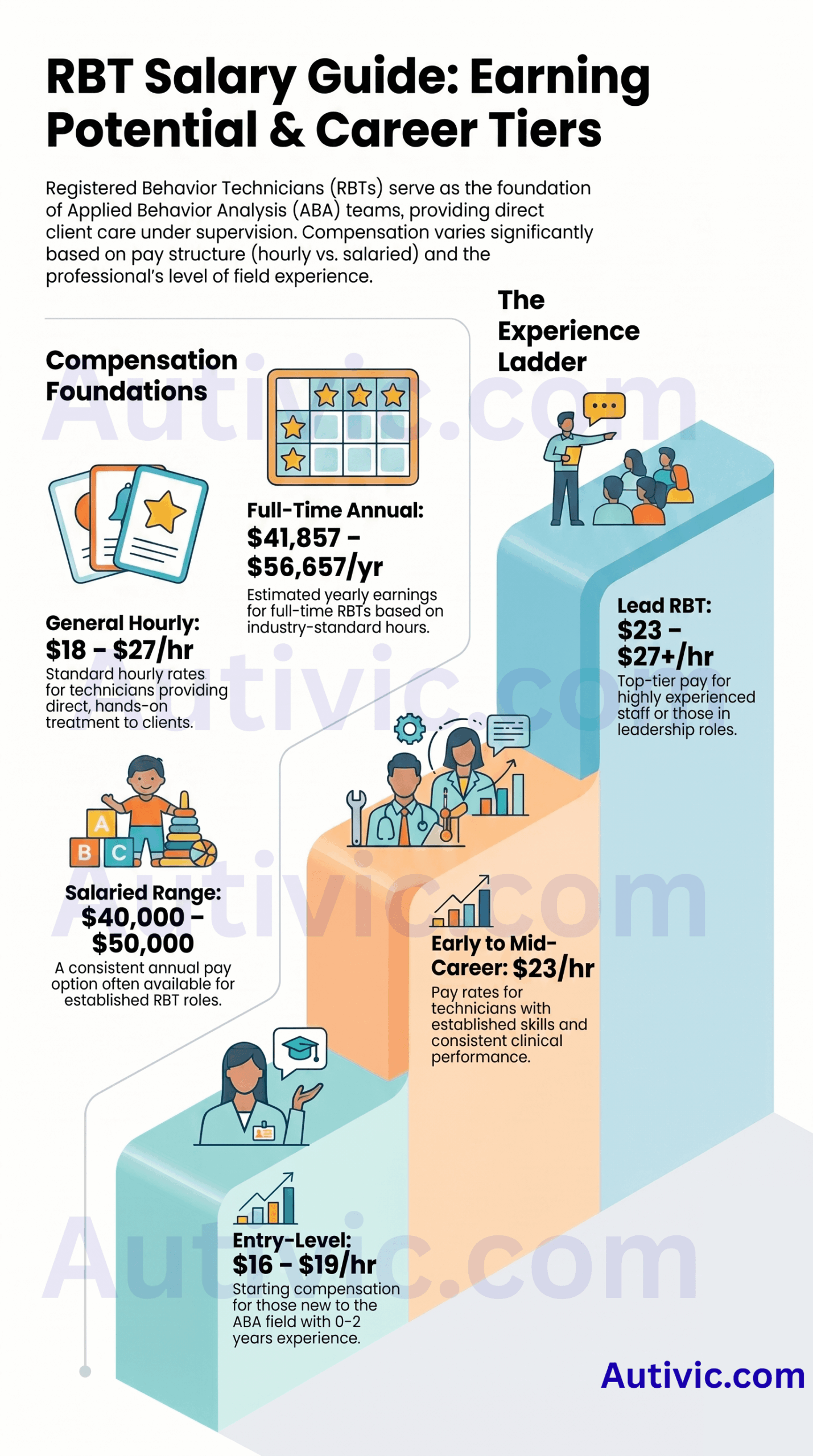
In 2026, RBTs (Registered Behavior Technicians) are usually paid by the hour. They typically earn between $18 and $27 per hour. This charge varies based on their experience, where they live, and who they work for.
Across the U.S., a full-time RBT can expect to earn about $41,857 to $56,657 per year. That makes it around $20.13 to $27.24 per hour.
But the salary range also varies depending on the amount of time that they have spent in this industry. If we narrow it down:
Entry-level RBT (newly certified, little or no earlier ABA experience):
They often begin on the lower end, which is around $16–$19 per hour. They opt for smaller agencies, school districts, or lower-cost-of-living areas. This is what the child builder site says.
Early to mid-career RBT (1–3+ years, stable performance):
We found from ZipRecruiter that RBTs normally earn around $19–$23 per hour. This is true if they work particularly in busy clinics or home-based agendas in suburban or urban markets.
Highly experienced or lead RBT (several years, advanced skills, mentoring others):
This is the highest they can get. This can reach $23–$27+ per hour in competitive markets, particularly in states like California, New York, or New Jersey, or in roles with extra responsibilities such as commanding newer technicians and managing difficult cases.
But if someone is hired or salaried instead of hourly, RBTs are supposed to calculate it according to a 35-40-hour workweek. In this way, the range becomes $40,000 to $50,000 annually.
RBT Salary and Hourly Wage Breakdown
| Experience Level | Hourly Rate | Estimated Annual Salary | Key Factors / Work Settings |
|
Entry-Level
(Newly certified, little to no experience) |
$16.00 – $19.00 | $33,280 – $39,520 | Smaller agencies, school districts, lower-cost-of-living areas |
|
Early to Mid-Career
(1 to 3+ years of stable performance) |
$19.00 – $23.00 | $39,520 – $47,840 | Busy clinics, home-based setups in suburban or urban markets |
|
National Average Range
(Overall U.S. full-time spectrum) |
$20.13 – $27.24 | $41,857 – $56,657 | Varies widely based on total experience, location, and employer |
|
Maximum Typical Range
(High-end hourly cap) |
$23 – $27.00 | Up to $56,160 | Highly experienced professionals, high-cost-of-living areas |
How location affects the numbers
Location will affect the salary range, as the richer the city is, the more the worker gets paid.
- Costly Places: In states like California, New York, and Massachusetts, RBTs usually get paid the most. This can stretch to $25 or more per hour in big cities.
- Reasonably Priced Places: Regions such as Texas, Florida, and North Carolina are in the middle, and the rates are usually around $18 to $22 per hour.
- Cheaper Places: RBTs’ starting pay might be closer to $16 to $18 per hour. There is little or no scope for salary increments.
Things to be aware of: RBT jobs that require a lot of touring or are done remotely occasionally offer a little extra money or benefits. But the base pay is the same as for offline jobs.
What influences RBT’s salary?
RBTs are paid in a usual range depending on experience and location. But that’s not how it’s entirely dependent upon. We found out that there are other factors surrounding these. If we were to list all those down:
1. Depends on your experience: The more experience you have, the more your wallet gets heavier. If you are good at managing data and addressing complex client situations, or if you become a lead RBT who guides others, your salary increment is possible.
2. Depends on your geographical location: The richer the city is, the more you’ll get paid in full. That is, pay is often more satisfactory in big cities or places where the cost of living is high. The pay might be more inferior but things like rent and travel are also low, so there’s no loss in this. But do your research before committing.
3. Depends on your work setting: If we were to classify those work settings:
- Private Agencies: They usually offer good pay and offer extra work hours as they focus on ABA principles.
- Hospitals: They offer fair pay and benefits. If it’s a more serious behavior issue, you can expect more pay from them.
- Schools: This one pays a little less comparatively per hour, but they offer steady daytime work. You’ll also get holidays off, following the school calendar.
4. The special skills and training that you have : Skills will open doors that you didn’t know existed. If you have special skills like dealing with very difficult behaviors, working with very young kids, or communicating through a second language, you’re good to go. Or if you have a casual leadership background, you are more likely to get an increment or drive into a higher-paid lead position. You can get certified as a BCaBA or BCBA later on and thus reach a new level of career and pay.
5. Expected total pay and company help: The hourly pay is just one part of the deal. There are other factors involved, too. Specialties like health insurance, paid time off (PTO), retirement savings plans, and paid training can elevate the whole work experience. Most of the time, a lower hourly pay with outstanding benefits and stable work hours is more reasonable than a higher pay with unsatisfactory advantages and inconsistent working hours.
Final take
If you are still with us, you have seen it all – the real deal of RBT life.
We have discussed the hands-on sessions, predicted a solid $18-$27 per hour pay, and came to the conclusion that it is a doable amount. The whole journey is challenging, but it is game-changing if you do it the right way.
What’s the right way?
If you ask us, it is simple: watch clients grow, build your resume, and finally, climb up to BCBA levels.
But whatever you do, make sure to go through all the sections of this article. Know the locations, the pros and cons of that, and how ready you are for the next process.
Now that you have researched, get certified fast, pick whatever you think is right for you, and enjoy the benefits. Your move is now – nothing’s stopping you from starting today!

Ohita Salam
Ohita Salam is a lead content author at Autivic, where she specializes in curating research-driven, clear, and pragmatic educational resources and blogs to assist aspiring RBTs i.e. Registered Behavior Technicians in learning ABA principles, key RBT concepts, and their practical applications efficiently.
- Ohita Salam

- Ohita Salam
- Ohita Salam
- Ohita Salam