If your dream career involves working with at-risk individuals and kids with functional and developmental disabilities such as autism, ADHD, etc., then it’s a great idea to become a Registered Behavior Technician i.e. an RBT. And to practice as one, you need to obtain the RBT certification first.
However, that’s only the first step in the journey. After you pass the coveted RBT exam and gain your acclaimed RBT certification, you still need to work under a supervisor and maintain your code of conduct to retain your certification as an RBT practitioner.
The RBT career is not only fulfilling in terms of public service but also a monetarily rewarding one. By working as an RBT full-time, you can earn up to $35k to $50k+ in a year. The amount varies from state to state in the USA.
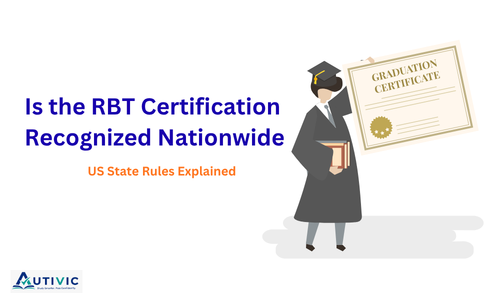
And that often brings up a common question – is the RBT certification recognized nationwide in the United States?
The RBT certification is indeed recognized nationwide i.e. in all 50 states of the United States. In addition to the USA, it’s also recognized in Canada, Australia, and the United Kingdom as per BACB’s RBT Handbook.
Almost all of the states grant state licensure to RBT professionals readily upon application with required documentation. However, some states may impose a couple of state-specific requirements before you can practice as an RBT.
In today’s write-up, we’ll go over the nationwide recognition of the RBT certification and what it means for RBT professionals. We’ll explain the US State rules for practicing RBTs in addition to the perks that come with it.
So, without further ado, let’s get right to it.
Is The RBT Certification Recognized Nationwide?
Yes, the RBT certification is recognized nationwide in the United States. That means, this certification can be exercised in all 50 states of the USA.
So, once you obtain the RBT certification, it’s an official recognition of your proficiency in ABA domains and paraprofessional services. Wherever you work, whether at a clinic or a school, or a private company, this certification will act as proof of your competency as a behavioral specialist.
But, what will happen if you move to a different state? What’s the extent of this ‘nationwide’ recognition for RBTs?
The answer, you guessed it already, is that the RBT certification is indeed transferrable. That means if you get certified in Oklahoma, you don’t have to get recertified in, let’s say, Massachusetts, New York, Wyoming, etc. separately.
State Licensure Vs. Nationwide Recognition Of The RBT Certification: What’s The Difference?
Note that nationwide recognition doesn’t automatically grant you state licensure as a Registered Behavior Technician.
The RBT certification is authorized and regulated by the BACB. It’s recognized nationwide i.e. in all the USA states, as well as in Canada, Australia, and the UK.
However, while many of the USA states will let you practice with just the RBT certification, some may require state licensure separately.
That means, before the RBTs can provide any behavioral therapy in these states, they must get licensed by the state officially. And this state licensure is granted not by the BACB, but by the licensing board of that particular state.
Most of the USA states have their own licensure board for behavioral analysts such as RBTs, BCBAs, BCaBA’s, etc. to regulate their code of conduct. For instance – Alabama has the Alabama Behavior Analyst Licensure Board or ALABA, Arizona has AzABA, Oklahoma has OKABA, and so on.
To sum up, while the RBT certification is nationwide, the state licensure isn’t. That means, you need to obtain the state licensure or an equivalent of the state that you’re practicing/living in separately. Again, not all states require a license in the first place to practice as an RBT or a BCBA.
The best thing, under these circumstances, would be to simply notify your employer, and they will likely take care of the rest. If you don’t need a state-specific license, you can get to work right away with your certification.
And if you do, you will need to simply apply for state licensure and that’s it.
US State Rules For RBT Certification: Specifications & Exceptions
As of 2026, around 40 out of 50 USA states require state-specific ABA licensure for RBT practitioners. For instance:
- Nevada
- Oklahoma
- Arizona
- New York
- Massachusetts
- Oregon
- Washington,
- Wyoming, etc.
You can find the entire list of states here for further inquiry.
On the other hand, the following states do not have any specific licensing board and as such, they do not apply any formal licensing laws to RBTs:
- California
- Delaware
- Florida
- Colorado
- New Hampshire
- New Mexico
- South Carolina, etc.
As of 2024, if you wish to practice in these states, you don’t need anything beyond an RBT certification as they don’t have specific ABA regulations. Under such circumstances, an RBT certification will provide you with all the credentials you need to work in the behavioral health & treatment sectors.
If you’re still unsure, it’s always a great idea to look into the regional ABA licensing standards and regulations of your state. You can also seek the advice and assistance of your supervisor or your employer directly.
US State RBT Earnings Statistics: A Comparison Table
According to BACB, there are over 240k+ registered behavior technicians in the United States alone as of December 2025.
Typically, an RBT receives hourly wages instead of annual salaries. If you’re new to the field, you may expect to earn around $15-$18 every hour. Those who have mid-range experience earn up to $20-$25 every hour and lastly, most senior RBTs with 10+ years of experience earn up to $25-$30 per hour.
According to ZipRecruiter, RBTs earn $56,657 on average nationwide in the USA. In Florida, the annual average is around $42,339 for RBTs.
However, this amount is only an estimate, and not necessarily a fixed one. Your earnings as an RBT depends on the following factors – experience, additional certification (for instance – the BCBA certification), practice area, private/public setting, and overtime facilities.
In 2022, the demand for behavioral analysts such as BTs, RBTs, BCBAs, and BCBAs went up by 23%, as reported by BACB’s US Employer Demand For Behavioral Analysts. It’s only expected to go higher in the upcoming years.
Here’s a comparison table that showcases the average earnings of Registered Behavior Technicians around the states in the USA:
| Serial | State | Average Annual RBT Earnings |
| 1. | California | $45k-$50k |
| 2. | Los Angeles | $42k-$52k |
| 3. | New York | $42k-$52k |
| 4. | Massachusetts | $40k-$50k |
| 5. | Connecticut | $38k-$48k |
| 6. | New Jersey | $37k-$47k |
| 7. | Texas | $32k-$42k |
| 8. | Florida | $30k-$42k |
| 9. | Georgia | $28k-$38k |
To sum up, well-known cities with a flourishing economy pay better than small cities and rural areas. An RBT in California may explore more jobs and overtime facilities, and thus earn more than an RBT in Oklahoma or Pasadena.
Retention of RBT Certification: Expert Tips For RBT Practitioners In The United States
If you wish to retain your ‘Active’ status as an RBT practitioner, you must meet the following regulations efficiently:
1. Meet The Supervision Quota
Your supervisor must supervise you for a minimum of 5% of your work hours monthly. That means, for every 100 hours you spend providing ABA services in the public or the private healthcare sector, you must stay under direct supervision of a certified BCBA or BCaBA for a minimum of 5 hours.
Fun but important fact to note – if you have multiple employers, then you cannot share the total number of supervision hours among them.
That means, if you have, let’s say, three employers, then you must fulfill the 5% quota with all three of them separately. You can’t share your responsibilities across organizations as that’ll constitute a direct violation of the ethical code.
2. Arrange For Monthly Supervisory Contacts
An RBT must have at least two monthly supervisory contacts every month with their assigned supervisor. Of these two contacts, one must involve individual supervision so that the supervisor can determine whether the RBT practices are up to code according to the updated ABA guidelines.
3. Renew Your Certificate
As of January 1, 2026, a certified RBT must renew their certification every two years. They no longer need to complete a competency assessment for certification renewal, rather they must complete 12 PDU i.e. Professional Development Units instead. It costs $50 for the RBT renewal application.
4. Adhere To The RBT Ethics Code 2.0
All certified RBTs must adhere to the RBT Ethics Code 2.0 to retain their certification and exercise it in the medical and behavioral field. If they fail to comply with the BACB regulations, they will get flagged and reported to the BACB board. They will remain suspended until further investigation.
As for retention of state-specific licensure, a practicing RBT may have to fulfill some additional requirements such as –
5. Background Checks
Various states or employers may ask for additional background checks before letting an RBT practice in the ABA field. This is to ensure that the RBT in question has exhibited no criminal behavior in the past towards at-risk clients.
6. Medicaid or Insurance Coverage
The state or the employer may also urge the RBT to update their Medicaid or Insurance Billing information for further reliability and professionalism.
And no, this isn’t necessarily a complex procedure at all. Typically, your employer will arrange for you to get credentialed with insurance companies (or Medicaid) so that they include you in their insurance plans for funding. Your employer or company will even do the paperwork on your behalf.
Nationwide Recognition of RBT Certification: Perks & Importance
As a certified RBT, your main task is to implement the guidelines set by BCBA’s to treat or arrange for inventions for at-risk individuals as needed. Due to the nationwide recognition of RBT certification, you can exercise your acquired RBT skills and get into the following sectors anywhere in the USA:
- Public and private schools
- Home-based caregiving
- Elderly Assistance
- Academic institutes
- Clinics & Diagnostic Centers
- Mental hospitals and organizations
- Community-specific programs
- Autism & ADHD diagnosis centres
- Teletherapy and teletherapy
- Private institutes and ABA-specific organizations
- Online platforms for RBT exam practice
You can level up with more experience and work with multiple organizations at once after you get your RBT certification. Typically, the pay scale is slightly higher in the private sectors than the public ones. Hence, many RBTs often tend to gain BCBA or BCaBA certification to move up the ladder.
As an RBT, you’ll provide any or all of the following services to the community regardless of your location i.e. state:
- Provide Direct Behavioral Assistance: You’ll work with at-risk kids or adults to identify their behavioral patterns and preferences to provide direct assistance with their issues.
- Implement Behavior Intervention and Reduction Strategies: By identifying their behavioral issues, you’ll work to curate intervention sessions to reduce their odd and unsocial behavioral patterns.
- Actively Collect and Measure Behavioral Data: You’ll collect behavioral data, measure it against ABA parameters, document it for further research, and identify behavioral patterns accordingly.
- Act As A Caregiver : You’ll act as a caregiver with at-risk individuals who struggle to maintain social contact and offer patience so that they may feel safe and untroubled.
- Offer Extended Therapy In Private Sectors : You can move in-house to offer extended professional therapy to certain individuals who need 24/7 care and treatment to get back to normal life.
Final Verdict
So, is the RBT certification recognized nationwide? Turns out, it very much is!
However, the RBT certification doesn’t equate to state licensure. That means, even if you have the certification, it doesn’t necessarily mean that you have the license to practice in a particular state.
But that’s not necessarily a problem either. In most USA states, you can easily apply for state licensure if you’ve already got the RBT certification. You can even transfer between states without having to take the RBT test again.
Your only job is to maintain your certification i.e. adhere to the ethical codes and meet supervision requirements dedicatedly. And of course, you must renew your certification every two years, as per the 2026 BACB guidelines.
Frequently Asked Questions
How much does it cost to get RBT certification?
It can cost anywhere from $95- $200+ to get RBT certification. Officially, you need to pay a $50 background check fee and $45 RBT exam fee. If you opt for 40-hour RBT training courses instead of the free material, your cost will go up.
How long does it take to get certified as an RBT?
It takes around 2-3 months to get certified as an RBT. You need to first complete the background check and then the 40-hour RBT training which can take up to 2-6 weeks. Afterward, you need to finish the RBT competency assessment, and then you can finally sit for the 90-minute RBT exam.
Do I still need a supervisor after I pass the RBT exam?
Yes, a supervisor is needed not only for the competency assessment but also for certified RBTs. Even after passing the RBT exam, you’ll need a BCBA or BCaBA to add you as a supervisee to their BACB account to be an active RBT.
Which fundamental RBT skills does the 40-Hour Training cover?
The 40-Hour RBT Training primarily covers the fundamental ABA therapy theories and real-life applications including data collection and analysis methods, measurement and assessment techniques, skill acquisition methods, behavior intervention and reduction procedures, etc.

Ohita Salam
Ohita Salam is a lead content author at Autivic, where she specializes in curating research-driven, clear, and pragmatic educational resources and blogs to assist aspiring RBTs i.e. Registered Behavior Technicians in learning ABA principles, key RBT concepts, and their practical applications efficiently.
- Ohita Salam

- Ohita Salam
- Ohita Salam
- Ohita Salam